

Image via Fortinet
Table of Contents
The Modern Security Challenge
Security operations centers (SOCs) today are under constant strain. Teams must process overwhelming volumes of “data noise” generated across distributed environments—firewalls, endpoints, email systems, and cloud platforms. Within the Fortinet ecosystem alone, tools such as FortiGate, endpoints, and cloud telemetry continuously generate alerts that demand attention.
At the same time, threats are evolving faster than ever. AI-driven attacks—including polymorphic malware, advanced phishing campaigns, and zero-day exploits—are specifically designed to evade traditional detection methods. These threats adapt in real time, making manual investigation and response increasingly ineffective.
This creates a critical gap: human analysts can no longer keep up using conventional tools and workflows.
To address this, organizations need more than another standalone tool. They require an intelligent, AI-driven layer embedded directly within their security and networking infrastructure—one that can interpret, correlate, and act across the entire environment.
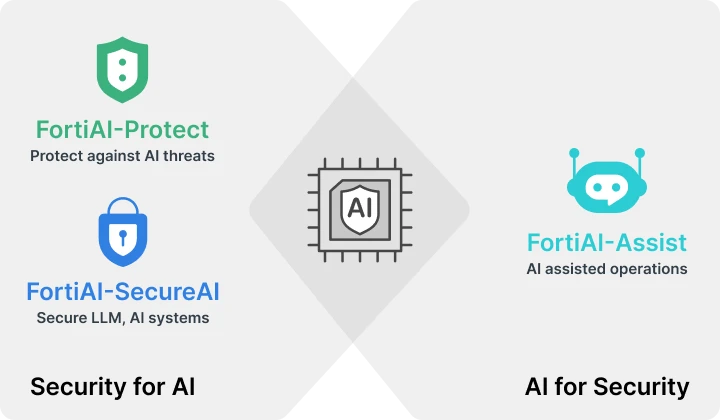
Image via Fortinet
FortiAI: Seeing, Speaking, and Acting
FortiAI represents a shift from passive AI assistance to agentic AI embedded across the Fortinet Security Fabric.
Unlike traditional chatbots, FortiAI is deeply integrated into Fortinet systems and operates across three core capabilities:
- Sees: Correlates logs, alerts, and telemetry across devices and platforms
- Speaks: Enables natural language interaction for queries and commands
- Acts: Executes multi-step workflows autonomously without repeated prompts
This marks a fundamental shift from reactive, query-driven support to autonomous, end-to-end security operations integrated directly into the infrastructure.
Unlike standalone LLMs, FortiAI is context-aware. Because it is embedded within the Fortinet Security Fabric, it understands the network topology and real-time logs, enabling it to generate precise CLI and Jinja scripts for complex configurations without manual coding.
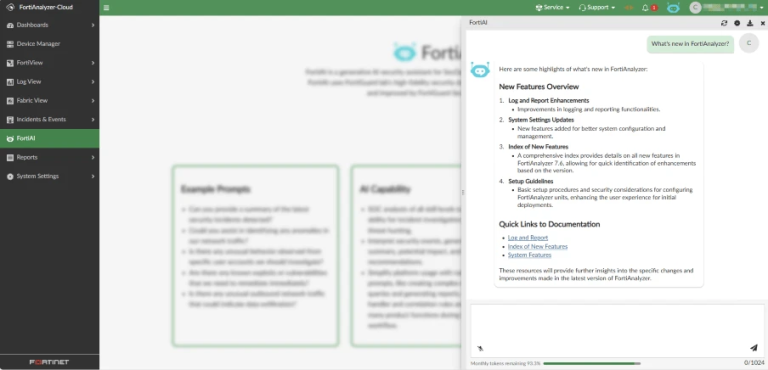
Image via Fortinet
The Four Pillars of AI-Driven Operations
To deliver autonomous, end-to-end security and network operations, FortiAI is built on four core pillars. Each one addresses a key challenge faced by modern SOC and network teams—bringing together intelligence, automation, and control within the Fortinet Security Fabric.
1. Analyst in Your Pocket (Assist)
This pillar transforms how teams interact with their infrastructure by introducing a natural-language-driven interface for both troubleshooting and deployment. Instead of navigating multiple tools or relying on manual CLI commands, analysts can engage systems conversationally and receive immediate, actionable outcomes.
For example, a simple query such as “Why is the VPN slow?” triggers automated root-cause analysis. FortiAI correlates telemetry across devices and layers to pinpoint the exact source of the issue—whether it is a misconfiguration, a congested link, or a specific user endpoint.
Core Capabilities
- Plain-language queries for diagnostics and operations
- Automated, cross-layer root-cause analysis
- Context-aware insights without manual investigation
Deployment Acceleration
Beyond troubleshooting, FortiAI significantly simplifies complex deployment tasks within Fortinet environments:
- Generates CLI and Jinja scripts directly from conversational input
- Interprets network topology diagrams for accurate configuration
- Automates BGP and VPN setup on Fortinet hardware
Operational Speed and SOC Efficiency (Automate)
The second pillar addresses the inefficiencies of traditional SOC workflows. Manual processes, fragmented tools, and constant context switching often slow down response times and increase operational overhead.
FortiAI resolves this by translating high-level intent into automated, multi-step actions. Working alongside platforms like FortiSOAR, it orchestrates tasks across the environment from a single instruction. Its agentic behavior allows it to maintain context throughout the workflow, moving seamlessly from detection to response without repeated input.
This automation significantly improves operational efficiency, accelerating device provisioning, simplifying complex configurations such as BGP and VPN, and enabling faster onboarding for SOC teams. For critical changes, administrators can set “Human-in-the-Loop” (HITL) checkpoints to ensure oversight when modifying core routing tables or managing executive-level accounts.
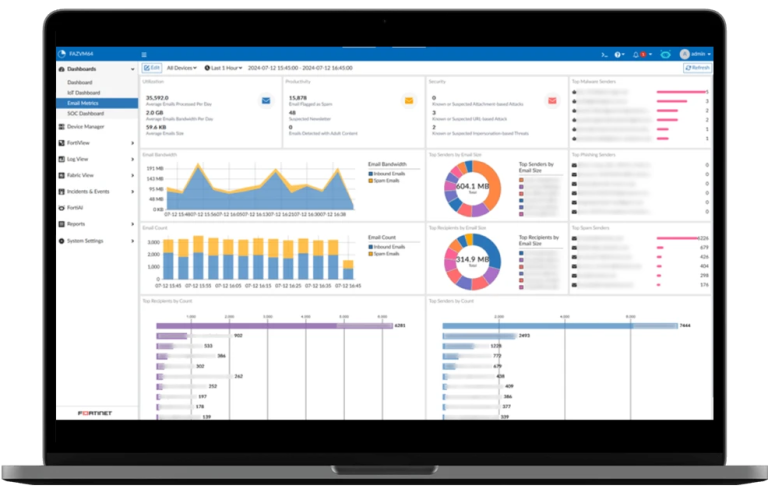
Image via Fortinet
Real-Time Defence (Protect)
The third pillar ensures that automation is matched with strong, real-time protection. FortiAI continuously monitors network activity, correlating signals and threat intelligence to detect and stop attacks the moment they appear.
It is designed to block AI-powered malware, zero-day threats, and advanced multi-stage attacks before they can establish a foothold. In addition, FortiAI provides visibility into AI-related applications and URLs used across the organization, helping to identify suspicious behavior such as data exfiltration or malicious command-and-control activity.
This proactive approach enables organizations to respond instantly to evolving threats without relying solely on manual intervention.
Securing AI Usage (SecureAI)
As AI adoption grows, organizations face a new category of risk known as Shadow AI. Uncontrolled use of external AI tools can introduce vulnerabilities such as prompt injection attacks, sensitive data leakage, and unauthorized automated interactions across systems.
FortiAI addresses these challenges through its SecureAI capabilities, which are designed to secure AI usage within the organization while maintaining governance and control.
Model Context Protocol (MCP) Visibility
A key component of SecureAI is Model Context Protocol (MCP) visibility, an open standard introduced by Anthropic. MCP enables secure connections between AI systems, external tools, and real-time data sources without requiring custom integrations.
By standardizing how context is shared between models and tools, MCP helps:
- Reduce integration complexity
- Improve interoperability across systems
- Ensure AI outputs are grounded in real-time, reliable data
- Minimize the risk of hallucinations in automated workflows
Through MCP visibility, FortiAI monitors agent-to-agent interactions, allowing organizations to detect hidden workflows, anomalous behaviors, or potentially malicious AI-driven activity.
Input Sanitization and Data Protection
In addition to visibility, FortiAI enforces strict input sanitization before any data is transmitted to external large language models. This process:
- Removes or neutralizes sensitive information
- Blocks prompt injection attempts
- Prevents unintended data exposure to external AI services
Together, these controls ensure that AI interactions remain secure, governed, and compliant with enterprise policies.
Integration with the Fortinet Ecosystem
The strength of FortiAI comes from its native integration within the Fortinet Security Fabric. It works seamlessly across platforms like FortiGate, FortiManager, FortiAnalyzer, FortiSIEM, FortiSOAR, and FortiNDR Cloud.
This integration enables shared intelligence across firewalls, endpoints, cloud, and SOC tools. When a threat is detected, FortiAI correlates data from multiple sources and takes coordinated, automated action in real time.
Because it is embedded within the ecosystem rather than a separate tool, FortiAI delivers true end-to-end automation and agentic security operations.
Proven Operational Impact
According to a 2025 Forrester Total Economic Impact™ study, organizations deploying Fortinet’s automated security solutions achieved a 308% Return on Investment (ROI).
- 50% Increase in NetOps Efficiency: Consolidating management eliminated redundant tasks.
- 75% Faster Response Times: Unified visibility allowed teams to resolve incidents significantly faster. Read the full Forrester TEI Report here
Prioritising Data Privacy and Enterprise Control
A common concern with AI is the security of the data it uses. Fortinet addresses this by processing all data locally on Fortinet devices, ensuring strict data sovereignty. Customer information and internal network telemetry are never shared with or used to train external AI models.
At the same time, FortiAI benefits from continuous updates from FortiGuard Labs, bringing global threat intelligence without compromising local privacy. This approach ensures that automation remains both secure and reliable.
As a result, enterprises can confidently adopt AI-driven operations. Analysts predict that by 2026, AI will influence up to 20% of initial network configurations, a sharp increase from almost none in 2023—highlighting the growing impact of secure, enterprise-controlled AI.
Written by a Senior Security Architect (NSE-certified) with hands-on experience deploying FortiAI across enterprise environments.
Unlocking a New Era for the SOC
FortiAI transforms how SOC teams operate, shifting them from manual, fragmented workflows to intelligent, autonomous operations embedded directly within the Fortinet Security Fabric. Analysts gain integrated, real-time visibility across firewalls, endpoints, cloud, and SOC tools, enabling faster, more accurate decisions.
By simplifying Day 0 deployment and automating complex network configurations, even junior staff can handle tasks that once required senior engineers. Organizations using FortiAI can achieve up to 98% automation in remediation, a 60% boost in team efficiency, and a 40% reduction in operational costs—all while keeping data local and under enterprise control.
FortiAI turns AI-driven intelligence into actionable, secure, and measurable results, redefining the modern SOC.
To learn more or arrange a demo, contact our team or your authorized Fortinet partner to discuss FortiAI deployment options for your environment.